
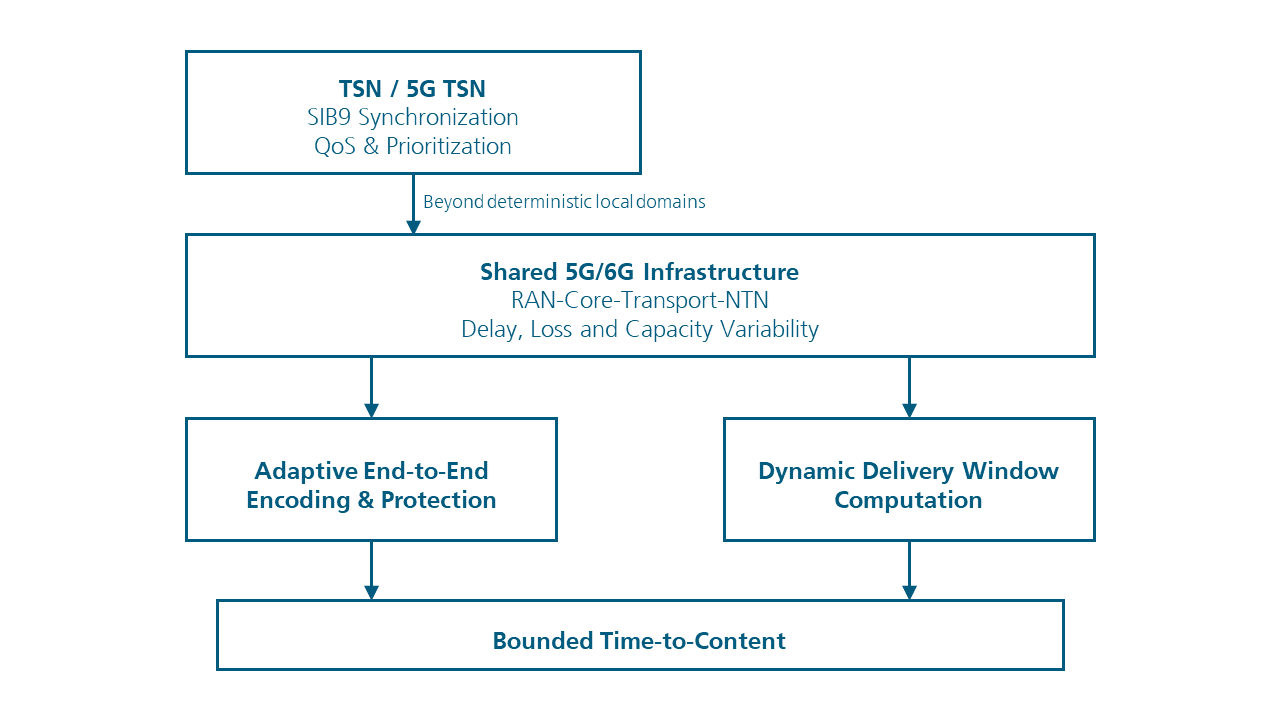
Fraunhofer FOKUS investigates how 5G/6G networks can provide deterministic end-to-end communication over shared and dynamically changing infrastructure. Earlier work on TSN integration and SIB9-based time synchronization provides the timing foundation. Current research moves beyond this toward adaptive end-to-end determinism.
QoS and prioritization ensure that critical traffic receives preferential treatment, but they do not by themselves guarantee deterministic delivery. Our research therefore combines end-to-end reliability with dynamic computation of the delivery window, based on current delay, loss behavior, traffic rate and available capacity.
The network can then adapt end-to-end encoding and protection mechanisms, path selection and transmission parameters to the observed conditions and required reliability and delay bounds. The objective is predictable time-to-content even when the underlying network is variable.
Research Topics
- End-to-end deterministic communication
- Dynamic delivery-window computation
- End-to-end reliability
- Time-to-content determinism
- Adaptive end-to-end encoding and protection
- Packet-level protection across heterogeneous paths
- QoS-aware prioritization
- Adaptation to delay, loss and capacity variation
- Deterministic communication across TN and NTN
Open6GCore provides the timing, QoS, programmable data-path, reliability and observability mechanisms required to investigate adaptive end-to-end deterministic 6G communication.
| © Fraunhofer FOKUS