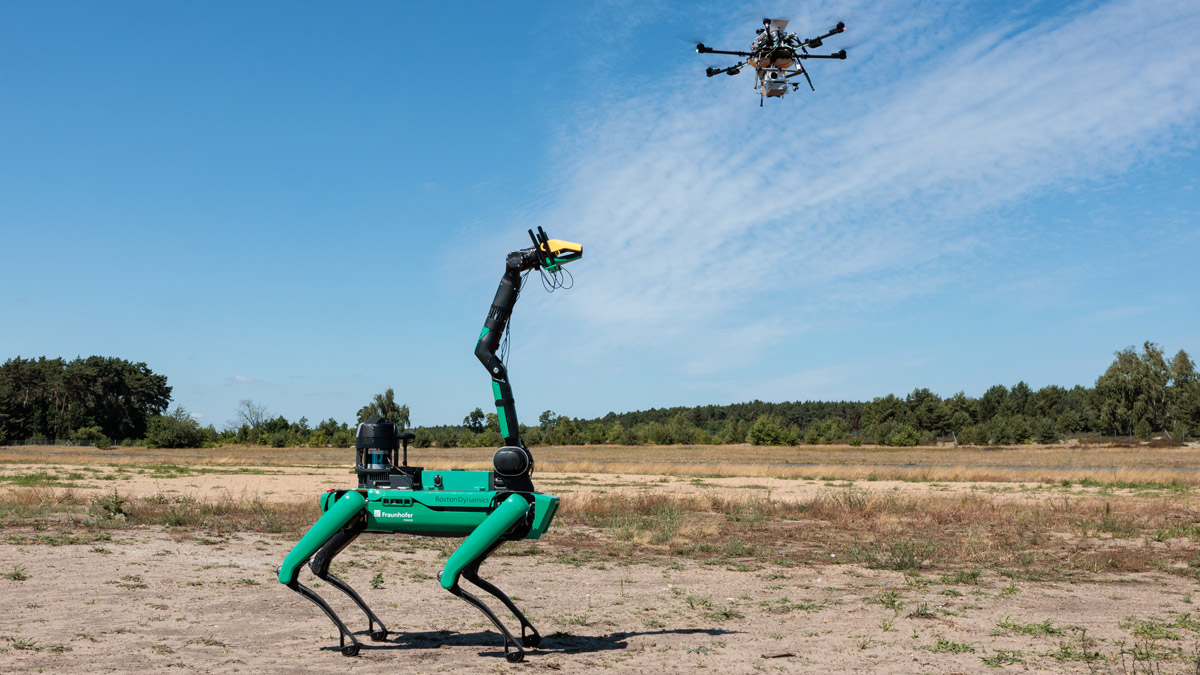
Fraunhofer FOKUS investigates how 5G/6G networks can support AI systems operating in the physical world. Physical AI and cyber-physical systems such as robots, drones, autonomous vehicles and intelligent machines increasingly depend on communication with other devices, edge intelligence, sensors, and shared infrastructure.
Their communication is highly heterogeneous. A mobile autonomous system may simultaneously exchange control information, sensor and perception data, AI inference requests, shared environmental information, model updates and background telemetry. These flows require different levels of latency, reliability, bandwidth, priority, and availability. Our research investigates how 5G/6G networks can provide the appropriate QoS, bearers, and data paths for each type of traffic.
A particular focus is local and direct communication. Communication between cooperating robots, drones, sensors and nearby edge intelligence should use short and efficient paths whenever possible instead of unnecessarily traversing remote network infrastructure. Local breakout, edge processing, and dynamically selected shortcut paths can reduce delay and support fast interaction between distributed AI components.
For safety-relevant and time-sensitive Physical AI, average low latency is insufficient. Communication must remain predictable. Fraunhofer FOKUS therefore investigates deterministic data flows, QoS-aware scheduling, bandwidth allocation and bounded-delay delivery. Existing work classifies traffic according to bearer, criticality and timing requirements and schedules its forwarding within predefined deterministic windows.
Distributed AI systems must also continue to operate as communication conditions, topology and available compute resources change. Our research therefore considers the joint adaptation of network paths, communication resources, and edge/cloud computation to maintain the communication properties required by the AI application.
Research Topics
- Networks for Physical AI and cyber-physical systems
- Communication for robots, drones and autonomous systems
- Robot-to-robot and machine-to-machine coordination
- Edge AI and distributed inference
- QoS and bearer configuration for AI data flows
- Deterministic and bounded-delay communication
- Shared sensing, perception and environmental information
- Communication-compute coordination
- Mobility-aware AI service placement
- High-volume sensor, model and training-data transfer
Open6GCore provides the distributed deployments, the network control, QoS mechanisms, programmable data paths, edge integration and observability required to investigate how 5G/6G networks can become an active infrastructure for distributed AI and Physical AI systems.