
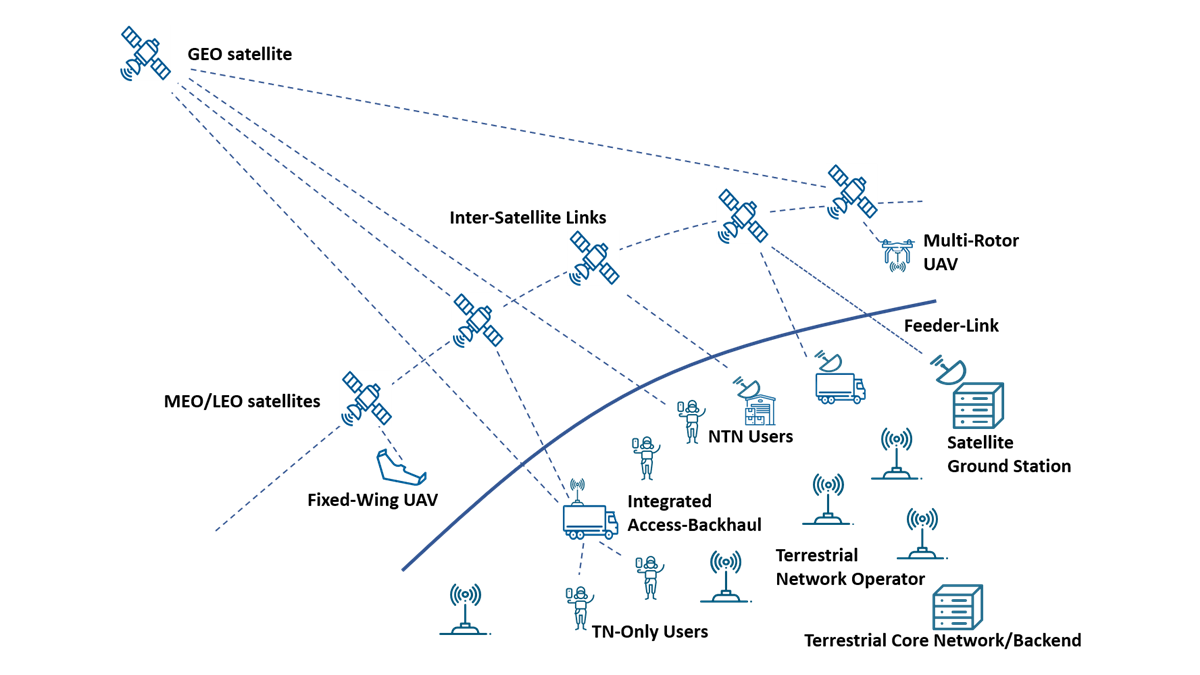
6G extends the mobile network into three dimensions. Terrestrial cells, satellites, aerial platforms, mobile infrastructure and edge/cloud resources increasingly must operate as parts of the same communication system rather than as separate networks.
Fraunhofer FOKUS has worked on this convergence for many years. ESA SATis5 started in 2017 with the integration of satellite connectivity into a real 5G test environment. Since then, the research has progressed through projects including BMBF 6G-TakeOff, ESA 5GEOSiS, ESA 6G SmartSAT, SNS JU 5G-STARDUST and BMFTR 6G-Coverage, moving from satellite integration toward unified TN-NTN architectures, multi-layer satellite networks, distributed processing and seamless mobility.
The research now addresses networks whose topology, coverage and available connectivity change continuously. Users may move between terrestrial and non-terrestrial access, satellites themselves move relative to users and ground infrastructure, and different satellite layers or terrestrial systems may provide alternative paths at the same time. Maintaining service therefore requires predictive access selection, TN-NTN and NTN-NTN mobility, coordinated handovers and continuity of network state. In 6G-Coverage, FOKUS is specifically working on seamless TN-NTN / NTN-NTN mobility, predictive handovers, core-side preparation and large-scale 3D-network validation.
At the same time, satellites are becoming more than communication relays. ESA 5GEOSiS investigates repurposable processing capabilities in space, while ESA 6G SmartSAT addresses routing and networking across multi-layer satellite systems. Together with work in 5G-STARDUST and 6G-TakeOff, this moves toward a 3D network in which communication, routing, processing and network functions can be distributed across terrestrial and non-terrestrial infrastructure.
Open6GCore provides the core-network side for these experiments, while OpenLANES enables large-scale emulation of dynamic terrestrial and satellite topologies. This allows new mobility, routing and architectural concepts to be tested as complete end-to-end
TN-NTN systems rather than as isolated satellite links.
Research Topics
- Unified terrestrial and non-terrestrial network architectures
- 3D and multi-layer communication networks
- TN–NTN and NTN–NTN mobility
- Predictive and uninterrupted handovers
- Service continuity across changing coverage
- Dynamic topology and access selection
- Routing in multi-layer satellite networks
- Distributed processing and network functions in space
- Repurposable satellite platforms
- Large-scale TN/NTN emulation and validation
| © Fraunhofer FOKUS